|
1.
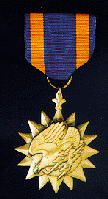
Description: A bronze compass rose 1 11/16 inches circumscribing
diameter and charged with an eagle volant carrying two lightning flashes
in its talons. A fleur-de-lis at the top point holds the suspension ring.
The points of the compass rose on the reverse are modeled with the central
portion plain for engraving the name of the recipient.
2.
Ribbon: The ribbon is 1 3/8 inches wide and consists of the
following stripes: 1/8 inch ultramarine blue 67118; ¼ inch golden orange
67109; center 5/8 inch ultramarine blue; ¼ inch golden orange; and 1/8
inch ultramarine blue.
3.
Criteria: The Air Medal is awarded to any person who, while serving
in any capacity in or with the armed forces of the United States, shall
have distinguished himself by meritorious achievement while participating
in aerial flight. Awards may be made to recognize single acts of merit or
heroism or for meritorious service. Award of the Air Medal is primarily
intended to recognize those personnel who are on current crew member or
non-crew member flying status which requires them to participate in aerial
flight on a regular and frequent basis in the performance of their primary
duties. However, it may also be awarded to certain other individuals whose
combat duties require regular and frequent flying in other than a
passenger status or individuals who perform a particularly noteworthy act
while performing the function of a crew member but who are not on flying
status. These individuals must make a discernible contribution to the
operational land combat mission or to the mission of the aircraft in
flight. Examples of personnel whose combat duties require them to fly
include those in the attack elements of units involved in air-land
assaults against an armed enemy and those directly involved in airborne
command and control of combat operations. Involvement in such activities,
normally at the brigade/group level and below, serves only to establish
eligibility for award of the Air Medal; the degree of heroism, meritorious
achievement or exemplary service determines who should receive the award.
Awards will not be made to individuals who use air transportation solely
for the purpose of moving from point to point in a combat zone.
4.
Components: The following are authorized components of the Air
Medal and the applicable specifications for each:
a.
Decoration (regular size): MIL-D-3943/23. NSN for decoration set is
8455-00-269-5747. For replacement medal NSN 8455-00-246-3837.
b. Decoration
(miniature size): MIL-D-3943/23. NSN 8455-00-996-5002.
c. Ribbon:
MIL-R-11589/7. NSN 8455-00-252-9963.
d. Lapel Button:
MIL-L-11484/17. NSN 8455-00-257-4308.
5.
Background: a. In a letter from the Secretary of War to the
Director, Bureau of Budget, dated 9 March 1942, the Secretary submitted a
proposed executive order establishing the Air Medal for award to any
person who, while serving in any capacity of the Army of the United
States, distinguishes himself by meritorious achievement while
participating in an aerial flight The Secretary of War, in his request,
stated "The Distinguished Flying Cross is available only for heroism or
extraordinary achievement while participating in aerial flight…It is
desired not to cheapen the Distinguished Flying Cross by awarding it for
achievement not bordering on the heroic. It is, however, important to
reward personnel for meritorious service."
b. The
Air Medal was authorized by President Roosevelt by Executive Order 9158,
dated 11 May 1942, and established the award for "any person who, while
serving in any capacity in the Army, Navy, Marine Corps or Coast Guard of
the United States subsequent to September 8, 1939, distinguishes, or has
distinguished, himself by meritorious achievement while participating in
an aerial flight." Authorization was announced in War Department Bulletin
No. 25, dated 25 May 1942. Executive Order 9242-A, dated 11 September 1942
amended the previous Executive Order to read "in any capacity in or
with the Army".
c. In
July 1942, the Office of The Quartermaster General (OQMG), forwarded a
letter to twenty-two artists offering an opportunity to submit designs for
consideration. The design selected was submitted by Walker Hancock and
approved by the Secretary of War on 31 December 1942. The designer, Walker
Hancock, had been inducted into the Army and assigned to Camp Livingston,
Louisiana. He was ordered to temporary duty effective 16 November 1942 to
G1 War Department to work on the medal. The Chief of Staff approved the
ribbon design prepared by OQMG on 26 August 1942.
d. Oak
leaf clusters were initially used to denote subsequent awards of the Air
Medal. The number of additional awards were so great that the oak leaf
clusters did not fit on the ribbon. As a result, the policy was changed in
September 1968 to require the use of numbers to indicate subsequent awards
of the Air Medal.
e. The
Air Medal may be awarded for service during peacetime; however, approval
authority for peacetime awards is not delegated to field commanders.
f. Order
of precedence and wear of decorations is contained in Army Regulation (AR)
670-1. Policy for awards, approving authority, supply, and issue of
decorations is contained in AR 600-8-22. |