|
1.
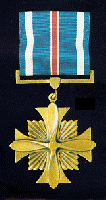
Description: A bronze cross patee on which is superimposed a
four-bladed propeller, 1 11/16 inches in width. Five rays extended from
the reentrant angles, forming a one-inch square. The medal is suspended
from a rectangular shaped bar.
2.
Ribbon: The ribbon is 1 3/8 inches wide and consists of the
following stripes: 3/32 inch Ultramarine Blue 67118; 9/64 inch White
67101; 11/32 inch Ultramarine Blue 67118; 3/64 inch White 67101; center
stripe 3/32 inch Old Glory Red 67156; 3/64 inch White 67101; 11/32 inch
Ultramarine Blue 67118; 9/64 inch White 67101; 3/32 inch Ultramarine Blue
67118.
3.
Criteria: The Distinguished Flying Cross is awarded to any person
who, while serving in any capacity with the Armed Forces of the United
States, distinguishes himself by heroism or extraordinary achievement
while participating in aerial flight. The performance of the act of
heroism must be evidenced by voluntary action above and beyond the call of
duty. The extraordinary achievement must have resulted in an
accomplishment so exceptional and outstanding as to clearly set the
individual apart from his comrades or from other persons in similar
circumstances. Awards will be made only to recognize single acts of
heroism or extraordinary achievement and will not be made in recognition
of sustained operational activities against an armed enemy.
4.
Components: The following are authorized components of the
Distinguished Flying Cross:
a. Decoration
(regular size): MIL-D-3943/15. NSN 8455-00-269-5748 for decoration set.
NSN 8455-00-246-3826 for individual replacement medal.
b. Decoration
(miniature size): MIL-D-3943/15. NSN 8455-00-996-5006.
c. Ribbon:
MIL-R-11589/47. NSN 8455-00-252-9967.
d. Lapel
Button (metal replica of ribbon): MIL-L-11484/11. NSN 8455-00-253-0807.
5.
Background: a. The Distinguished Flying Cross was established in
the Air Corps Act (Act of Congress, 2 July 1926, Public Law No. 446, 69th
Congress). This act provided for award "to any person, while serving in
any capacity with the Air Corps of the Army of the United States,
including the National Guard and the Organized Reserves, or with the
United States Navy, since the 6th day of April 1917, has
distinguished, or who, after the approval of this Act, distinguishes
himself by heroism or extraordinary achievement while participating in an
aerial flight."
b. Various
designs from the U.S. Mint, commercial artists, and the Office of the
Quartermaster General, were submitted to the Commission of Fine Arts and
on 31 May 1927. The Commission approved a design submitted by Mr. Arthur
E. Dubois and Miss Elizabeth Will.
c. Initial
awards of the Distinguished Flying Cross were made to persons who made
record breaking long distance and endurance flights and who set altitude
records. The Secretary of War authorized the first Distinguished Flying
Cross to Captain Charles A. Lindbergh in a letter dated 31 May 1927. With
the support of the Secretary of War, the Wright Brothers retroactively
received the Distinguished Flying Cross. This award required a special Act
of Congress, since the law precluded award to civilians.
d. The
current statutory requirements for award of the Distinguished Flying Cross
to Army personnel is contained in Title 10, U.S.C., Section 3749; Section
6245 for Navy personnel; and Section 8749 for Air Force personnel.
Enlisted personnel may be entitled to a 10% increase in retired pay under
Title 10, U.S.C., Section 3991, when credited with heroism equivalent to
that required for the award of the Distinguished Service Cross.
e. Order of
precedence and wear of decorations is contained in Army Regulation 670-1.
Policy for awards, approving authority, supply, and issue of decorations
is contained in Army Regulation 600-8-22. |