|
UNITED STATES ARMY
Description:
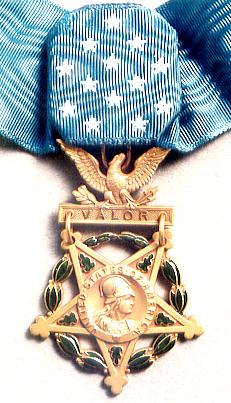
A gold five pointed star, each point tipped with trefoils, 1 ½ inches
wide, surrounded by a green laurel wreath and suspended from a gold bar
inscribed "VALOR", surmounted by an eagle. In the center of the star,
Minerva’s head surrounded by the words "UNITED STATES OF AMERICA." On each
ray of the star is a green oak leaf. On the reverse is a bar engraved "THE
CONGRESS TO" with a space for engraving the name of the recipient.
Ribbon:
The medal is suspended by a neck ribbon, 1 3/8 inches wide, Bluebird
67117. A shield of the same color ribbon with thirteen White (67101)
stars, arranged in the form of three chevrons is above the medal. The
service ribbon is 1 3/8 inches wide with five White stars in the form of a
"M".
Criteria:
The Medal of Honor is awarded by the President, in the name of Congress,
to a person who, while a member of the Army, distinguishes himself or
herself conspicuously by gallantry and intrepidity at the risk of his or
her life above and beyond the call of duty while engaged in action against
an enemy of the United States; while engaged in military operations
involving conflict with an opposing foreign force; or while serving with
friendly foreign forces engaged in an armed conflict against an opposing
armed force in which the United States is not a belligerent party. The
deed performed must have been one of personal bravery or self-sacrifice so
conspicuous as to clearly distinguish the individual above his or her
comrades and must have involved risk of life. Incontestable proof of the
performance of the service will be exacted and each recommendation for the
award of this decoration will be considered on the standard of
extraordinary merit.
Background:
a.
General George Washington had created the Badge of Military Merit on 7
August 1792 but it had fallen into disuse after the Revolutionary War.
Decorations, as such, were still too closely related to European royalty
to be of concern to the American people. However, the fierce fighting and
deeds of valor during the Civil War brought into focus the realization
that such valor must be recognized. Legislation was introduced in the
Senate on 17 February 1862, which authorized the medal for the Army and
followed the pattern of a similar award approved for Naval personnel in
December 1861. The Resolution provided that: "The President of the United
States be, and he is hereby, authorized to cause two thousand "medals of
honor" to be prepared with suitable emblematic devices, and to direct that
the same be presented, in the name of Congress, to such noncommissioned
officers and privates as shall most distinguish themselves by their
gallantry in action, and other soldier-like qualities during the present
insurrection, and the sum of ten thousand dollars be, and the same is
hereby appropriated out of any money in the Treasury not otherwise
appropriated, for the purpose of carrying this resolution into effect."
b. The
original design for the Army was created by Christian Schussel and
engraved by Anthony C. Pacquot. The pendant was identical to the design
approved by the Navy, with the exception of the suspension and clasp. It
consisted of a five-pointed star, tipped with trefoils containing a crown
of laurel and oak. In the middle, a band of 34 stars represented the
number of States in 1862. Minerva, personifying the United States, stands
with a left hand resting on fasces and right hand holding a shield
blazoned with the United States arms. She repulses Discord, represented by
snakes. The pendant was suspended by a trophy of crossed cannons, balls,
sword and an American eagle. The clasp was two cornucopias and the arms of
the United States.
c. The
initial law was amended by an Act of Congress on 3 March 1863 to extend
its provisions to include officers.
d. In
1896, misuse of the medal led to a change in the design of the ribbon
because the original had been imitated by nonmilitary organizations. This
change was authorized by Joint Resolution of Congress, Fifty-Fourth
Congress, Sess. I, 2 May 1896. At this time a bowknot (rosette) was
adopted to be worn in lieu of the medal. The ribbon and bowknot (rosette),
established and prescribed by the President, was promulgated in War
Department Orders dated 10 November 1896.
e. On
23 April 1904, Congress authorized a new design of the medal. The design
adopted at that time was designed by Major General George L. Gillespie and
is the one currently in use. The medal was worn either suspended from the
neck or pinned over the left breast in precedence to other military
decorations.
f. The
present neck ribbon was adopted in 1944. It is worn outside the shirt
collar and inside the coat, hanging above all other decorations.
g.
Special entitlements for recipients of the Medal of Honor include:
(1) Each Medal of
Honor awardee may have his name entered on the Medal of Honor Roll (38 USC
560). Each person whose name is placed on the Medal of Honor Roll is
certified to the Department of Veterans Affairs as being entitled to
receive the special pension of $400 per month.
(2) Enlisted
recipients of the Medal of Honor are entitled to a supplemental uniform
allowance.
(3) Special
entitlements to air transportation under the provisions of DOD Regulation
4515.13-R.
(4)
Identification card, commissary and exchange privileges for Medal of Honor
recipients and their eligible dependents.
(5) Children of
recipients are eligible for admission to the U.S. Service Academies
without regard to the quota requirements.
(6) Ten percent
increase in retired pay under Title 10, USC 3991, subject to the 75% limit
on total retired pay.
UNITED STATES NAVY
Description:
The current Navy Medal of Honor is a five-pointed bronze star, tipped with
trefoils containing a crown of laurel and oak. In the center is Minerva,
personifying the United States, standing with left hand resting of fasces
and right hand holding a shield blazoned with the shield from the coat of
arms of the United States. She repulses Discord, represented by snakes.
The medal is suspended from the flukes of an anchor.
UNITED STATES AIR
FORCE
Description:
Within a wreath of Green laurel, a Gold five-pointed star, one point down,
tipped with trefoils and each point containing a crown of laurel and oak
on a Green background. Centered on the star, an annulet of 34 stars is a
representation of the head of the Statue of Liberty. The star is suspended
from a bar inscribed with the word "VALOR" above an adaptation of the
thunderbolt from the Air Force Coat of Arms. |