|
1. Description:
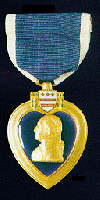
A Purple heart within a Gold border, 1 3/8 inches wide, containing a
profile of General George Washington. Above the heart appears a shield of
the Washington Coat of Arms (a White shield with two Red bars and three
Red stars in chief) between sprays of Green leaves. The reverse consists
of a raised Bronze heart with the words "FOR MILITARY MERIT" below the
coat of arms and leaves.
2.
Ribbon: The ribbon is 1 3/8 inches wide and consists of the
following stripes: 1/8 inch White 67101; 1 1/8 inches Purple 67115; and
1/8 inch White 67101.
3.
Criteria: a. The Purple Heart is awarded in the name of the
President of the United States to any member of an Armed Force who, while
serving with the U.S. Armed Services after 5 April 1917, has been wounded
or killed, or who has died or may hereafter die after being wounded;
(1)
In any action against an enemy of the United States;
(2)
In any action with an opposing armed force of a foreign country in which
the Armed Forces of the United States are or have been engaged;
(3)
While serving with friendly foreign forces engaged in an armed conflict
against an opposing armed force in which the United States is not a
belligerent party;
(4)
As a result of an act of any such enemy of opposing armed forces;
(5)
As the result of an act of any hostile foreign force;
(6)
After 28 March 1973, as a result of an international terrorist attack
against the United States or a foreign nation friendly to the United
States, recognized as such an attack by the Secretary of the department
concerned, or jointly by the Secretaries of the departments concerned if
persons from more than one department are wounded in the attack; or,
(7)
After 28 March 1973, as a result of military operations, while serving
outside the territory of the United States as part of a peacekeeping
force.
(8)
After 7 December 1941, by weapon fire while directly engaged in armed
conflict, regardless of the fire causing the wound.
(9)
While held as a prisoner of war or while being taken captive.
b. A
wound for which the award is made must have required treatment by a
medical officer.
4. Components:
a.
Decoration (regular size): MIL-D-3943/24; NSN for set 8455-00-269-5757;
individual medal 8455-00-246-3833.
b.
Decoration (miniature size): MIL-D-3943//24.
c.
Ribbon: MIL-R-11589/126. NSN 8455-00-9948.
d. Lapel
Button (metal replica of ribbon bar): MIL-L-11484/18. NSN
8455-00-253-0818.
5.
Background: a. The original Purple Heart, designated as the Badge
of Military Merit, was established by General George Washington by order
from his headquarters at Newburgh, New York, August 7, 1782. The writings
of General Washington quoted in part:
"The General ever
desirous to cherish a virtuous ambition in his soldiers, as well as to
foster and encourage every species of Military Merit, directs that
whenever any singularly meritorious action is performed, the author of it
shall be permitted to wear on his facings over the left breast, the figure
of a heart in purple cloth or silk, edged with narrow lace or binding. Not
only instances of unusual gallantry, but also of extraordinary fidelity
and essential service in any way shall meet with a due reward".
b. So far
as the known surviving records show, this honor badge was granted to only
three men, all of them noncommissioned officers: Sergeant Daniel Bissell
of the 2d Connecticut Regiment of the Continental Line; Sergeant William
Brown of the 5th Connecticut Regiment of the Continental Line,
and Sergeant Elijah Churchill of the 2d Continental Dragoons, which was
also a Connecticut Regiment. The original Purple Heart depicted on the
first page is a copy of the badge awarded to Sergeant Elijah Churchill and
is now owned by the New Windsor Cantonment, National Temple Hill
Association, PO Box 525, Vails Gate, NY 12584. The only other known
original badge is the badge awarded to Sergeant William Brown and is in
the possession of The Society of the Cincinnati, New Hampshire Branch but
differs in design by not having any lettering embroidered on the heart and
the leaves are at the top only with a larger spray of leaves at the base.
c.
Subsequent to the Revolution, the Order of the Purple Heart had fallen
into disuse and no further awards were made. By Order of the President of
the United States, the Purple Heart was revived on the 200th
Anniversary of George Washington's birth, out of respect to his memory and
military achievements, by War Department General Orders No. 3, dated 22
February 1932. The criteria was announced in War Department Circular dated
22 February 1932 and authorized award to soldiers, upon their request, who
had been awarded the Meritorious Service Citation Certificate or were
authorized to wear wound chevrons subsequent to 5 April 1917.
d. During
the early period of World War II (7 Dec 41 to 22 Sep 43), the Purple Heart
was awarded both for wounds received in action against the enemy and for
meritorious performance of duty. With the establishment of the Legion of
Merit, by an Act of Congress, the practice of awarding the Purple Heart
for meritorious service was discontinued. By Executive Order 9277, dated 3
December 1942, the decoration was extended to be applicable to all
services and the order required that regulations of the Services be
uniform in application as far as practicable. This executive order also
authorized award only for wounds received.
e.
Executive Order 10409, dated 12 February 1952, revised authorizations to
include the Service Secretaries subject to approval of the Secretary of
Defense. Executive Order 11016, dated 25 April 1962, included provisions
for posthumous award of the Purple Heart. Executive Order 12464, dated 23
February 1984, authorized award of the Purple Heart as a result of
terrorist attacks or while serving as part of a peacekeeping force
subsequent to 28 March 1973.
f. The
Senate approved an amendment to the 1985 Defense Authorization Bill on 13
June 1985, which changed the precedent from immediately above the Good
Conduct Medal to immediately above the Meritorious Service Medals. Public
Law 99-145 authorized the award for wounds received as a result of
"friendly fire". Public Law 104-106 expanded the eligibility date,
authorizing award of the Purple Heart to a former prisoner of war who was
wounded before 25 April 1962.
g. The
National Defense Authorization Act for Fiscal Year1998 (Public Law 105-85)
changed the criteria to delete authorization for award of the Purple Heart
Medal to any civilian national of the United States while serving under
competent authority in any capacity with the Armed Forces. This change was
effective 18 May 1998.
h. Order
of precedence and wear of decorations is contained in Army Regulation
670-1. Policy for awards, approving authority, supply, and issue of
decorations is contained in AR 600-8-22. |